Pain just below the kneecap can interfere with running, gym training, padel, football and sports involving repeated jumping. You might notice discomfort during squats, lunges or stairs, or stiffness when you first start moving after sitting.
One possible cause is patellar tendinopathy, commonly known as jumper’s knee.
The condition can be frustrating because the knee may feel manageable during everyday activity but become painful when exposed to faster or heavier loading. Rest may settle the symptoms temporarily, yet the pain often returns when normal training resumes.
Successful rehabilitation therefore involves more than resting the knee. The patellar tendon needs to rebuild enough capacity for the running, jumping, lifting or sporting demands you want to return to.
What is patellar tendinopathy?
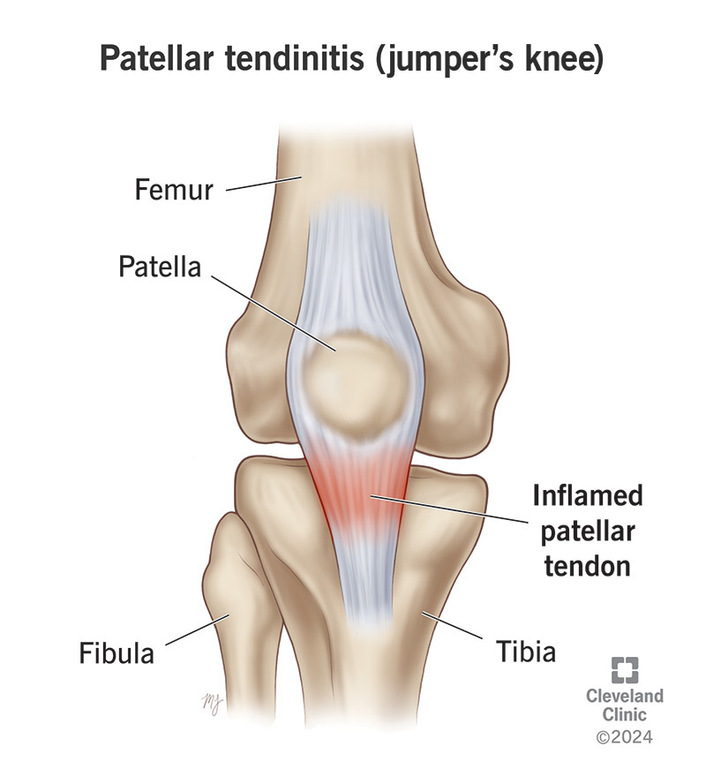
The patellar tendon connects the bottom of the kneecap to the shin bone. Together with the quadriceps muscles, it helps straighten the knee and absorb or produce force during walking, running, squatting, jumping and landing.
Patellar tendinopathy is a load-related condition associated with localised pain and reduced function in the tendon. Symptoms frequently develop when training demands increase more quickly than the tendon’s current ability to tolerate them.
Typical symptoms include:
- Pain immediately below the kneecap
- Localised tenderness over the patellar tendon
- Pain during jumping or landing
- Discomfort during squats, lunges or leg-extension exercises
- Pain when accelerating, sprinting or changing direction
- Stiffness at the beginning of activity
- Symptoms after training or the following morning
- Reduced confidence or power when jumping
NHS guidance describes patellar tendinopathy as pain, stiffness and weakness around the tendon below the kneecap, often associated with overloading or a change in activity. NHS Forth Valley
Is pain below the kneecap always patellar tendinopathy?
No. Pain at the front of the knee can come from several structures.
Other possible causes include:
- Patellofemoral pain
- Irritation of the fat pad below the kneecap
- Osgood-Schlatter-related symptoms in younger people
- A cartilage or joint problem
- Referred pain
- A partial or complete tendon injury
- Pain following previous knee surgery
Patellofemoral pain is commonly felt around or behind the kneecap, whereas patellar tendinopathy tends to produce more localised pain within the tendon itself. However, symptoms can overlap, and location alone does not confirm a diagnosis.
A clinical assessment can examine how the pain began, which activities reproduce it and whether another knee condition needs to be considered.
Why has the tendon become painful?
Patellar tendinopathy is particularly common in sports involving repeated jumping, sprinting and rapid changes of direction.
Potential contributors include:
- A sudden increase in training frequency
- Adding more jumping or plyometric work
- Increasing squat or leg-press loads
- Starting a new gym, HYROX or running programme
- Returning to sport after a break
- Increasing padel, tennis or football participation
- Reduced quadriceps or calf capacity
- Inadequate recovery between demanding sessions
- Combining heavy gym training with increased sport
- Continuing through progressively worsening symptoms
It is rarely helpful to blame one movement pattern or assume that the tendon is simply “tight”. Training history, recovery, strength and the demands of the person’s sport all need to be considered.
Should you stop sport completely?
Not necessarily. Reducing excessive tendon load can help settle symptoms, but prolonged complete rest does not rebuild the capacity required for sport.
You may be able to continue modified training when:
- Pain remains mild and stable
- You are not limping or changing your technique
- Symptoms settle soon after activity
- The knee is no worse the following morning
- Everyday walking and stairs remain comfortable
The activity may need to be reduced further when:
- Pain increases as the session continues
- Jumping or running technique changes
- The tendon remains aggravated into the next day
- Morning stiffness is progressively worsening
- Normal walking or stairs become painful
- Each session causes a larger reaction
Temporary changes might include reducing jumping volume, removing repeated sprints, limiting deep loaded squats or replacing one high-impact session with cycling.
NHS advice recommends remaining active where possible while adjusting aggravating loads and using lower-impact exercise to maintain fitness. NHS Forth Valley
What exercises help patellar tendinopathy?
Exercise is the central treatment, but the programme should progress according to symptoms and current ability.
Stage 1: Managing an irritable tendon
When the tendon is particularly sensitive, rehabilitation may begin with exercises such as:
- Isometric knee-extension holds
- Wall-sit holds
- Spanish squats
- Controlled leg press within a comfortable range
- Hip and calf strengthening
These exercises can begin rebuilding quadriceps capacity without immediately introducing high-speed jumping.
Stage 2: Progressive strength training
As the tendon becomes more tolerant, resistance can be increased through:
- Leg extensions
- Leg press
- Squats
- Split squats
- Step-ups and step-downs
- Slow, loaded knee-dominant exercises
- Calf and hip strengthening
The load should become meaningfully challenging rather than remaining at the same light resistance indefinitely.
A 2024 multidisciplinary guideline recommends progressive quadriceps resistance training for at least 12 weeks, with exercise intensity adjusted to the individual. It describes heavy, slow resistance as a useful approach while recognising that different contractions may be appropriate at different stages. esskajournals.onlinelibrary.wiley.com
Stage 3: Rebuilding energy storage
Strength alone does not prepare a tendon for the speed of running, jumping and landing.
Later rehabilitation may include:
- Pogo jumps
- Skipping
- Countermovement jumps
- Broad jumps
- Single-leg hopping
- Landing drills
- Acceleration and deceleration
- Change-of-direction exercises
- Sport-specific jumping patterns
These exercises should be introduced progressively and monitored for the response later that day and the following morning.
Are eccentric decline squats still recommended?
Eccentric decline squats have traditionally been used for patellar tendinopathy, but they are not the only treatment option.
A randomised clinical trial involving 76 people compared traditional pain-provoking eccentric exercise with a broader progressive tendon-loading programme. At 24 weeks, the progressive programme produced a greater improvement in pain, function and sporting ability. doi.org
This supports a staged approach that progresses from controlled strength work towards faster and more sport-specific loading, rather than prescribing one exercise to every patient.
Does patellar tendinopathy require a scan?
Not routinely. Diagnosis is usually based on the history and clinical examination.
An ultrasound or MRI may be considered when:
- The diagnosis remains uncertain
- There was a sudden traumatic injury
- Significant weakness is present
- The knee is swollen or locking
- A partial tendon tear is suspected
- Appropriate rehabilitation has not produced progress
- Imaging is required by a consultant
The 2024 guideline concluded that imaging has limited additional value in a typical patellar-tendinopathy presentation. Scan changes must also be interpreted alongside symptoms and function. pubmed.ncbi.nlm.nih.gov
Can shockwave therapy help?
Shockwave therapy may be considered for selected persistent cases, but it should not replace a comprehensive loading programme.
Research on shockwave for patellar tendinopathy remains mixed. A living systematic review found no short-term additional benefit when shockwave was added to eccentric exercise and recommended exercise as first-line treatment for at least three months before considering an adjunct. pubmed.ncbi.nlm.nih.gov
At Whitson Wellness, shockwave is therefore not presented as an automatic treatment or guaranteed solution. When clinically appropriate, it is provided alongside a personalised rehabilitation programme addressing strength, training load and return-to-sport demands.
When should knee pain be assessed urgently?
Seek prompt medical advice if you experience:
- A sudden snap or pop during activity
- Immediate severe pain or swelling
- Inability to straighten the knee
- Inability to bear weight
- A hot, red and swollen knee
- Fever or feeling systemically unwell
- A significant traumatic injury
- Rapidly worsening symptoms
These features may indicate a more acute injury or another condition requiring medical assessment.
Patellar tendinopathy physiotherapy in Amersham
At Whitson Wellness Physiotherapy, an assessment may include:
- Identifying the exact location and behaviour of the pain
- Reviewing recent changes in sport and gym training
- Assessing knee movement
- Measuring quadriceps, hip and calf strength
- Observing squats, lunges and step-downs
- Assessing jumping and landing when appropriate
- Reviewing running and change-of-direction demands
- Creating a progressive return-to-sport programme
Treatment is personally provided by Matt Whitson, an experienced Chartered Physiotherapist with a background in MSK rehabilitation, professional sport and strength-based return-to-performance planning.
Full gym access in Amersham allows rehabilitation to progress from early isometric exercises to loaded strength work, plyometrics and sport-specific preparation. Patients also attend from Chalfont St Giles, Little Chalfont, Chesham and surrounding Buckinghamshire.
If pain below your kneecap is limiting running, gym training or sport, book a physiotherapy assessment with Matt.
Move well. Live well.
FAQs
What is the difference between runner’s knee and patellar tendinopathy?
Runner’s knee commonly refers to pain around or behind the kneecap. Patellar tendinopathy usually causes more localised pain in the tendon immediately below the kneecap.
Can I train with patellar tendinopathy?
Modified training may be possible when pain remains mild and settles by the following day. Worsening symptoms, altered movement or difficulty with everyday activities indicate that load should be reduced.
Are squats bad for the patellar tendon?
No. Squats can form part of rehabilitation, but the depth, load and speed may need adjusting according to the tendon’s irritability.
How long does patellar tendinopathy take to improve?
Recovery varies, but structured rehabilitation commonly requires at least 12 weeks. Returning to unrestricted jumping sport can take longer.
Do I need an MRI?
Usually not. A clinical assessment is often sufficient. Imaging may be appropriate after trauma, when the diagnosis is unclear or when progress is not being made.
Can shockwave cure jumper’s knee?
No treatment can guarantee a cure. Evidence for shockwave is mixed, so progressive exercise remains the foundation of treatment.

Matthew Whitson
Contact Me